Data Management Glossary nnn
-
A
- Active Storage
- Adaptive Data Management
- AI Agents
- AI and Corporate Data
- AI Compute
- AI Data Extraction
- AI Data Governance
- AI Data Ingestion
- AI Data Leakage
- AI Data Management
- AI Data Pipelines
- AI Data Preparation
- AI Data Workflows
- AI Inferencing
- AI Infrastructure
- Air Gap
- Alternate Data Streams (ADS)
- Amazon (AWS) S3 Intelligent Tiering
- Amazon FSx
- Amazon Glacier (AWS Glacier)
- Amazon S3 (AWS S3)
- Amazon S3 Glacier Instant Retrieval
- Amazon Tiering
- Analytics-driven Data Management
- Application Programming Interface (API)
- Archival Storage
- Archiving
- Artificial Intelligence (AI)
- AWS DataSync
- AWS Lambda
- AWS Snowball
- AWS Storage
- Azure Data Box
- Azure NetApp Files
- Azure Storage
- Azure Tiering
-
C
- Capacity Planning
- Carbon footprint
- Carbon Usage Effectiveness
- Chain of Custody
- Chargeback
- Checksum
- Cloud Archiving
- Cloud Cost Optimization
- Cloud Costs
- Cloud Data Analytics
- Cloud Data Growth Analytics
- Cloud Data Management
- Cloud Data Migration
- Cloud Data Storage
- Cloud File Storage
- Cloud Migration
- Cloud NAS
- Cloud Object Storage
- Cloud Storage Gateway
- Cloud Tiering
- CloudPools
- Cold Data
- Common Internet File System (CIFS)
- Compression
-
D
- Dark Data
- Data Analytics
- Data Archiving
- Data Backup
- Data Center Consolidation
- Data Center Emissions
- Data Classification
- Data Curation
- Data Governance
- Data Hoarding
- Data Indexing
- Data Lake
- Data Lakehouse
- Data Lifecycle Management
- Data Lineage
- Data Literacy
- Data Management
- Data Management for AI
- Data Management Policy
- Data Migration
- Data Migration Chain of Custody
- Data Migration Plan
- Data Migration Software
- Data Migration Warm Cutover
- Data Mobilization
- Data Orchestration
- Data Protection
- Data Retention
- Data Retrieval
- Data Services
- Data Silos
- Data Sprawl
- Data Storage
- Data Storage Costs
- Data Storage Management Services (DSMS)
- Data Storage Optimization
- Data Storage Tags
- Data Tagging
- Data Tiering
- Data Transfer
- Data Virtualization
- Deduplication
- Deep Analytics
- Dell PowerScale
- Dell PowerScale SmartPools
- Department Showback
- Digital Business
- Digital Pathology Data Management
- Direct Data Access
- Director (Komprise Director)
- Disaster Recovery
- Dynamic Data Analytics
- Dynamic Links
-
E
-
F
-
G
-
H
-
I
-
K
-
M
-
N
-
O
-
P
-
R
-
S
- S3
- S3 Data Migration
- S3 Intelligent Tiering
- Scale-Out Grid
- Scale-Out Storage
- Secondary Storage
- Sensitive Data Detection
- Shadow AI
- Shadow IT
- Sharding
- Shared-Nothing Architecture
- Showback
- Smart Data Workflows
- SmartPools
- SMB Data Migration
- SMB protocol (Server Message Block)
- Solid State Drives (SSDs)
- Storage Area Network (SAN)
- Storage Array
- Storage as a Service
- Storage as a Service (STaaS)
- Storage Assessment
- Storage Costs
- Storage Efficiency
- Storage Insights
- Storage Metrics
- Storage Pool
- Storage Reclamation
- Storage Refresh
- Storage Tiering
- Stubs
- Sustainable Data Management
- Symbolic Link
- System Metadata
-
U
- Unstructured Data
- Unstructured Data AI
- Unstructured Data Analytics
- Unstructured Data Classification
- Unstructured Data Governance
- Unstructured Data Management
- Unstructured Data Migration
- Unstructured Data Preparation
- Unstructured Data Storage
- Unstructured Data Tiering
- Unstructured Data Workflows
- Unstructured Metadata
High Performance Storage
What is High Performance Storage?
High performance storage is a type of storage management system designed for moving large files and large amounts of data around a network. High performance storage is especially valuable for moving around large amounts of complex data or unstructured data like large video files across the network.
Used with both direct-connected and network-attached storage, high performance storage supports data transfer rates greater than one gigabyte per second and is designed for enterprises handling large quantities of data – in the petabyte range.
High performance storage supports a variety of methods for accessing and creating data, including FTP, parallel FTP, VFS (Linux), as well as a robust client API with support for parallel I/O.
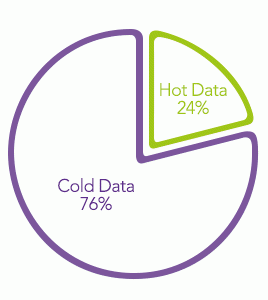
High performance storage is useful to manage hot or active data, but can be very expensive for cold/inactive data. Since over 60 to 90% of data in an organization is typically inactive/cold within months of creation, this data should be moved off high performance storage to get the best TCO of storage without sacrificing performance.
Is Cold Data Impacting Data Storage Performance?
Unstructured data management policies ensures that data is always stored in the appropriate environment according to its usage, age, value and business priority to maximize data storage performance and data storage costs.
Read: The Need for Policies to Corral Your Unstructured Data
Related Terms
Getting Started with Komprise:
- Learn about Intelligent Data Management
- Schedule a demonstration with our team
- Read the latest State of Unstructured Data Management Report