
This article was adapted from its original version on Intelligent CIO.
The year 2026 is shaping up to be a pivotal year for enterprise IT infrastructure budgets. While a year ago tariffs were the primary concern, now exploding demands for high-bandwidth memory (HBM) and high-capacity flash storage (NAND/SSDs) needed for AI infrastructure are adding to equipment shortages and price pressures.
In particular, DRAM and SSD prices may rise by more than 50% in some segments, according to CNBC, as memory inventory has fallen sharply in the past year. Meanwhile, cloud storage prices are projected to rise in lockstep due to cloud providers’ reliance on these components and an expected surge in demand from customers needing a capacity backup strategy. Memory and flash price increases are driving up the total cost of servers, storage arrays and cloud infrastructure, squeezing IT budgets and complicating long-term planning.
Devising ways to be more efficient with infrastructure and data storage will be a critical tactic in 2026, not only to deal with the current supply chain problems but for long-term competitive advantage.
Rethinking infrastructure procurement
For data storage teams and IT infrastructure and operations leaders, the storage and memory supply chain squeeze means that continually buying more capacity is no longer a viable strategy. Squeezing more value from existing resources with a focus on data lifecycle management can avoid getting caught in the middle of supply chain disruptions, which can happen at any time and for any reason.
There are a few critical strategies that come to play here:
- IT teams can optimize current infrastructure through better system tuning, right-sizing hardware and using automation to monitor systems for performance and efficiency.
- Re-evaluate vendor relationships on pricing and support.
- Consider and implement stockpiling (for products that have not yet gone up in price) and using the cloud as a backfill cautiously, backed by analytics.
- Implement a storage-agnostic unstructured data management strategy to control costs, preserve infrastructure value and reduce risk for the long term.
Why unstructured data is at the heart of the problem
While memory and storage are becoming more expensive and harder to obtain, enterprise data volumes aren’t slowing down, especially unstructured data.
In the Komprise 2026 State of Unstructured Data Management Report, 74% have more than 5PB of data and 40% are storing more than 10PB.
Without insight into what unstructured data is necessary, actively used, duplicates or low value, these files consume expensive storage tiers, pushing organizations toward costly capacity expansions. In this environment, reacting by simply buying more storage not only incurs costs and lead times but fails to address the root cause: uncontrolled data growth and bloat.
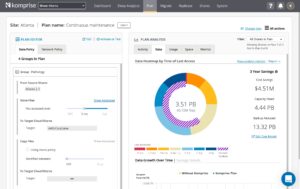
Komprise Intelligent Data Management Storage Planning Dashboard
Three reasons why unstructured data management is now essential
A modern unstructured data management strategy gives IT leaders the tools they need to act strategically rather than reactively.
- Lower storage costs by reducing bloat. Analytics-driven insights allow IT to understand data usage patterns and lifecycle needs. That way they can always place data where it should live given its current usage and value and get rid of data no longer needed such as orphaned, duplicate and outdated or irrelevant data. They can automatically tier cold or inactive data to low-cost storage tiers such as cloud object storage. This reduces pressure to buy new hardware, which is especially important during times of higher prices and shipping delays. Learn about Komprise transparent tiering and how it is more flexible and cost-advantageous than storage vendor tiering.
- Prioritize investments where they matter most. Not all data is equal and should not be treated the same. Gaining visibility across all storage including cloud gives IT infrastructure teams knowledge for decision-making. They can ensure that mission-critical datasets, including those supporting analytics and AI data pipelines, live on high-performance storage while less critical data moves to secondary or archival storage.
- Shrink the ransomware attack surface. Unstructured data silos are one of the top targets for ransomware and data breach attacks because they often lack consistent governance or visibility. A comprehensive unstructured data management strategy helps organizations identify stale, unmanaged or duplicate content.
The longer-term view for managing unstructured data
Industry analysts do not expect memory and storage markets to return to ‘normal’ pricing and availability soon. Meanwhile, unstructured data volumes will continue to grow.
IT infrastructure and operations leaders must choose between traditional reactionary tactics of buying additional expensive storage and backup systems as needed, if they can get it in time, or recentering on the data and how it can be managed differently based on business requirements, risk, value and age.
These decisions are not easy; IT teams are often bound by long-term vendor relationships, IT leadership preferences and the overall budget. Regardless of the near-term supply chain situation, a data-centric perspective to IT infrastructure procurement strategies can have positive, years-long benefits for the enterprise.
Komprise File Tiering v Storage Vendor Tiering: Know the Difference
As you evaluate tiering solutions from your storage vendor to reduce the need for additional capacity, consider the benefits of a storage-agnostic data management solution like Komprise.
- Komprise has flexible data tiering policies with a wide range of ages as well as exclusions based on size, file type, directory. Your storage vendor might say that same, but check to make sure.
- Komprise is non-disruptive: Komprise TMT uses symbolic links so user and application access never changes.
- Komprise is storage-agnostic, which means the solution can be deployed across most common storage arrays for a single view across all file and object storage. Each storage array only supports tiering to its own products with no global visibility.
- Komprise eliminates rehydration needs and costs by tiering data in its native format at the target for direct access and by allowing customers to configure when data should be rehydrated. As well, when moving tiered data to new storage, Komprise can move it directly without rehydration to the original storage. With storage vendor tiering, you must always rehydrate data and maintain primary storage capacity for that purpose.
- Komprise does not impact the hot data path. Komprise is involved only when cold data is accessed. This is not the case with storage vendor block-tiering methods that affect performance.





Leave a Reply